
Counselling support for people in Gosport, Fareham, Portsmouth, Stubbington, Lee on Solent and Titchfield
Research Focus -
The existential phenomenological experience of midlife
My research grows out of the same relational and existential foundations that shape my counselling work. I am drawn to the quiet, often unspoken experiences that accompany midlife: shifts in identity, the renegotiation of meaning, a changing relationship with time, and the subtle ways we come to inhabit our bodies and lives differently. Although these questions can touch both men’s and women’s lives, this research begins with women’s experiences of midlife. In time, it may open the way for
comparison with men’s experiences of this life transition, exploring where these experiences converge and where they differ. If you are a man reading these pages, please stay with me. This page offers an insight into the ideas guiding my research. It is written for clients, research participants, colleagues, and anyone curious about how research can illuminate the lived texture of being human. You may read these pages as information, and invitation to participate, or as a gently unfolding story that resonates with your own experience.
I am studying for an MA at the University of Chichester. My research has been endorsed by the Ethics Committee and is supported by an academic research supervisor. You can be assured of rigour and safety in process and outcomes.
Why I chose this research
Engaging with an MA has required commitment, focus, care, and time management within a demanding academic process. From the outset, there was pressure to shape a clear, robust research question — and, in many ways, the idea was choosing me.
As a woman in midlife, I have lived my own profound existential phenomenological transition — a story of love, loss, and lasting change. This raised questions of purpose and meaning that were often unvoiced and rarely invited by others, yet they shaped my mood, behaviour, choices, wellbeing, and midlife health.
At the heart of this research is the belief that midlife is more nuanced than many conversations allow. Something significant is missing: an understanding that honours women’s existential, emotional, spiritual, relational, and embodied lives alongside physiological change.

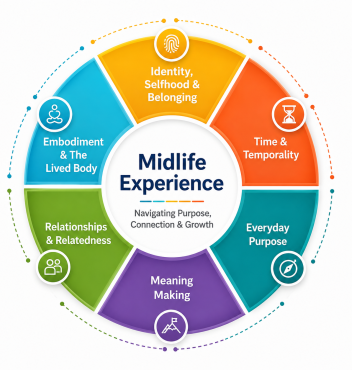
Early themes emerging that could shape the data are derived from my work with existentialism including
- Identity in motion —re‑shaping in response to changing roles, relationships, and inner longings.
- Embodiment —shifting relationship with the body, ageing, vitality, and the felt sense of inhabiting oneself.
- Time —urgency, spaciousness, nostalgia, and the desire to live more deliberately.
- Relationships — evolving connections with partners, children, friends, employoment and self.
- Purpose and everyday meaning — locating meaning in ordinary life, and changes to priorities.
- Meaning‑making — the deeper existential questions that surface: Who am I now? What matters? How do I live in alignment?
This is a starting point: an entry into the lived
experiences of women in midlife.
Why this research matters
Women’s midlife is often portrayed narrowly, with public and professional conversations focused on menopause and biology. This can leave little room for deeper questions of identity, meaning, loss, renewal, agency, and reorientation.
Through a phenomenological lens, this research aims to deepen understanding of women’s midlife experiences by:
Exploring women’s experiences of ageing — attending to the personal, relational, and existential dimensions of this transition, and moving beyond deficit-based or medicalised narratives.
Interpreting social and cultural influences — considering societal expectations, cultural messages, and media representations and how women navigate these narratives in midlife.
Giving voice to overlooked perspectives — documenting women’s own accounts of what ageing and challenging narrow or typical accounts of later life.
Informing counselling practice — helping practitioners recognise the complexity of midlife transition so that conversations about ageing are not reduced to biology alone.
Contributing to social research — addressing a gap in qualitative accounts in relation to the broader existential and relational dimensions of midlife in therapeutic contexts.
A phenomenological methodology
My study uses qualitative phenomenological inquiry to understand experience from within. Rather than imposing theory, I listen to how women describe their worlds.
This keeps the research:
relational — grounded in connection.
interpretive — attentive to meaning and context.
ethical — honouring autonomy and lived reality.
embodied — recognising experience as felt and spoken
It mirrors my therapeutic stance:
spacious, curious, and respectful of each person’s way of being
For clients and readers
Whether you are visiting as a client, someone exploring therapy, or
simply reading with interest, you do
not need to join the research to benefit from its insights. These themes may help you feel less alone, more understood, and better able to name what is unfolding in your life.
If you are interested in future research phases, please get in touch, I would be delighted to hear
from you. Participation is voluntary,
confidential, ethically governed by the University, and handled with care.
A closing note
(for now!)
This research is, at its heart, an invitation to slow down, listen inward, and recognise midlife as a rich, complex, and deeply human chapter.
I am honoured to be exploring midlife and grateful to those participants who have shown willing and enthusiasm in sharing their experiences that have and will shape this work.
Follow this page for updates and outcomes.
Academic Papers 2025 - 2026
Contact and Connection
Part A The use of self for contact and connection and how this is responded to in the therapy room. How contact and connection changes within different settings.
Part B Managing connection within a group process.
Existence
Part A - What it is to be human – a reflection on the existential philosophy of Kierkegaard, Heidegger, Sartre, Camus and Husserl.
Part B - The music of Pink Floyd – a creative podcast translating the songs of Pink Floyd into existential themes from death to birth and
survival in between.
Let's Talk
© Kathy Ellis Counselling
Powered by WebHealer